
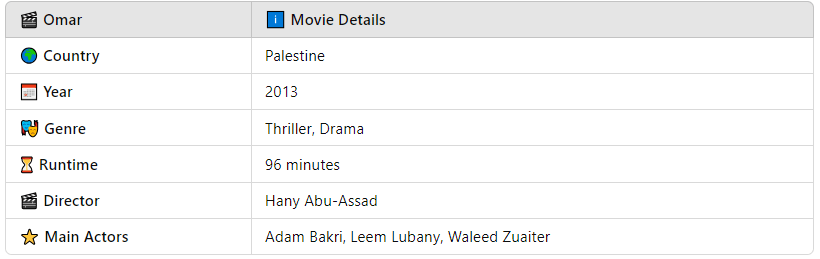
There’s a thin, nearly invisible thread that separates intimacy from danger in Omar, and it’s constantly under threat of snapping. This tightly wound story unfolds in occupied Palestine, where narrow alleyways echo with suspicion, and every leap over the separation wall could cost a life—or a friendship. It’s a film where the most mundane decisions—delivering bread, making a phone call, standing too long at a corner—can spiral into irreversible consequences.
What begins with a stolen moment of love and resistance soon becomes a psychological maze, a game of shadowed motivations and frayed loyalties. The plot unfolds with the tight precision of a thriller, but what lingers is its emotional complexity. There’s no clear exit from this world—only shifting thresholds of compromise, survival, and betrayal.
Shot with a raw, almost documentary-like eye, Omar captures the tension not only in action, but in stillness. The camera lingers on faces, pauses on silences, traces the contour of walls both physical and metaphorical. Abu-Assad crafts his narrative with minimalism and restraint, trusting the audience to feel the pressure building in every glance, every unfinished sentence. There’s nothing ornamental here—every frame feels urgent.
The film’s strength lies in its ability to personalize political trauma. The occupation is not a backdrop, but a force that penetrates love, friendship, and identity. It shapes the way people walk, speak, hide, and dream. Omar does not need to explain the conflict; it embeds it in every interaction, every camera angle, every hurried breath.
Adam Bakri, in his debut role, delivers a remarkably layered performance. He moves between defiance and vulnerability with ease, conveying a man who is constantly measuring risk—yet still dreaming of something pure. His character is not a hero in the traditional sense, but rather a young man navigating a moral labyrinth, trying to remain whole in a world that constantly asks him to fragment.
The supporting cast brings a quiet gravity to the film. Leem Lubany, as the romantic interest, adds a delicate, almost unreachable softness to the story, a reminder of what might have been. Eyad Hourani and the rest of the ensemble paint a portrait of friendship and camaraderie under siege, where even shared laughter carries weight.
There’s something especially powerful about the way the film handles betrayal—not as a plot twist, but as an atmospheric element. Suspicion is the air these characters breathe, and no one, not even the audience, is allowed the comfort of certainty. When the cracks appear, they don’t shock—they ache.
The editing is tight, almost claustrophobic, and the sound design subtly reinforces the emotional tone without ever overplaying it. No moment is overscored, no gesture exaggerated. The tension builds not through explosions, but through pauses, through the sight of a door half-open, or a glance held one second too long.
Winner of the Jury Prize at Cannes (Un Certain Regard) and nominated for an Oscar for Best Foreign Language Film, Omar garnered international recognition, but its impact is quieter, more personal. It’s a film that haunts through implication, through what’s left unsaid, through the echo of choices made in the shadows.
What elevates Omar beyond its genre is its emotional intelligence. It’s not just about politics—it’s about how politics invades the deepest corners of the private self. It’s about the impossibility of clean love, or unbroken trust, when every relationship is filtered through checkpoints, surveillance, and the constant risk of betrayal.
This is a film where every gesture has double meanings, and no decision is clean. There are no melodramatic speeches, no cathartic resolutions. Just people—young, wounded, trying to find a way to live and love in a world that never stops watching them.
And once it ends, it leaves behind the residue of unease, and a quietly devastating question:
What does freedom cost, when the personal and political are indistinguishable?
And more hauntingly: Is it possible to remain human under such conditions?
