
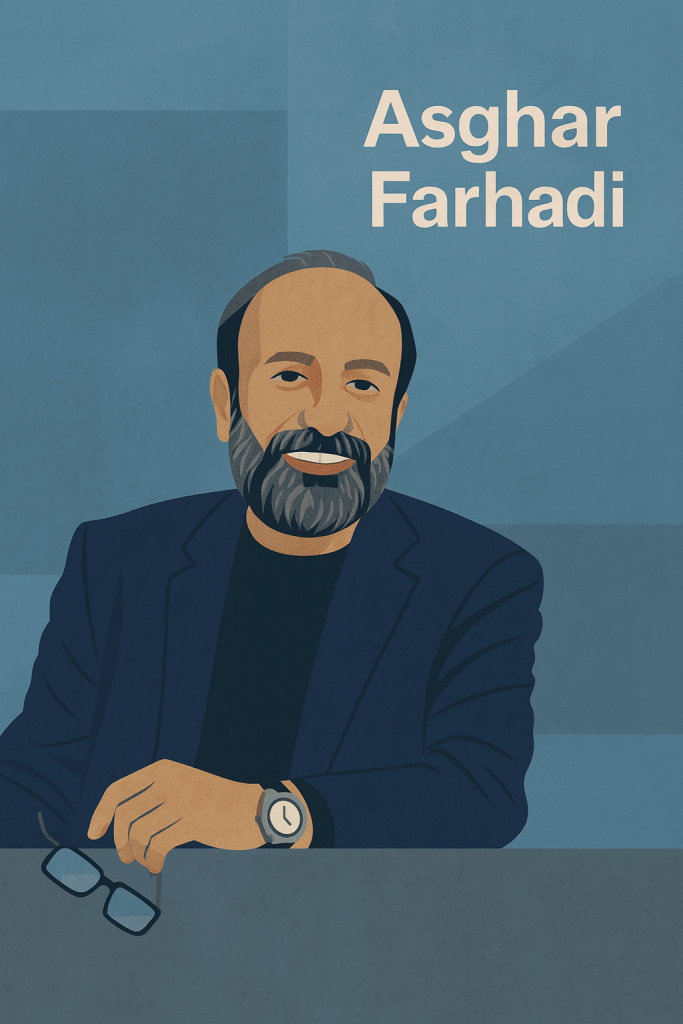
Few contemporary filmmakers have redefined the grammar of moral drama as decisively as Asghar Farhadi. Emerging from Iran’s rich yet tightly constrained cinematic tradition, Farhadi has built a body of work grounded in ambiguity, ethical tension, and the profound weight of ordinary decisions. His films—intimate, layered, and socially charged—have earned him global acclaim, including two Academy Awards, positioning him as one of the most influential auteurs in world cinema.
At a moment when global attention often reduces Iran to headlines, Farhadi insists on the human scale: families under strain, friendships tested by circumstance, and individuals caught between personal desires and collective expectations. His cinema is political only insofar as life is political; the forces pressing on his characters are subtle, pervasive, and devastatingly real.
Crafting Moral Suspense: From About Elly to Global Recognition
Farhadi’s international breakthrough, About Elly (2009), transformed a seaside getaway into a claustrophobic drama of omission, pride, and social pressure. The film’s razor-tight structure and emotional precision earned him the Silver Bear for Best Director at the Berlinale and established his reputation for constructing narratives where the truth is both fragile and contested.
His landmark film, A Separation (2011), elevated him to a global stage. Centering on a couple navigating divorce, caregiving, and a labyrinthine legal system, it won the Academy Award for Best Foreign Language Film, the Golden Bear, and numerous international prizes. With its handheld realism, densely layered dialogue, and moral nuance, A Separation confirmed Farhadi as a master architect of ethical cinema.
He continued this trajectory with The Past (2013) in France and The Salesman (2016), which earned him a second Academy Award, making him one of the few directors—anywhere—to win the category twice.
A Hero and the Fragility of Good Intentions
In A Hero (2021), Farhadi returned to Iran to explore one of his most socially incisive themes: how public image, pride, and institutional power shape moral judgment. The story of Rahim—a man who finds a lost bag of gold and becomes both celebrated and condemned for his actions—unfolds with the director’s signature slow-burn tension.
The film examines how acts of goodness can be weaponized, misunderstood, or swallowed by bureaucracy. Winning the Grand Prix at Cannes, A Hero reaffirmed Farhadi’s ability to portray morality not as a fixed ideal but as a volatile negotiation in a society governed by appearance and expectation.
Actors Who Bring Farhadi’s Worlds to Life
Farhadi’s cinema thrives on performance, and he has cultivated collaborations with some of the finest actors in Iranian cinema, whose emotional precision anchors his narratives:
- Leila Hatami, whose nuanced presence in A Separation remains one of the defining performances of Iranian cinema.
- Shahab Hosseini, a frequent collaborator and winner of Best Actor at Cannes for The Salesman.
- Taraneh Alidoosti, known for her layered, introspective performances in Fireworks Wednesday and The Salesman.
- Sareh Bayat, whose quiet intensity in A Separation added profound emotional depth.
- Sahar Dolatshahi, A Hero, bringing a grounded realism to Farhadi’s intricate moral terrain.
- Peyman Moaadi, whose conflicted and deeply human portrayal in A Separation helped cement the film’s global legacy.
These actors, often working in ensemble configurations, contribute to the emotional truthfulness and ethical friction that define Farhadi’s cinema.
Crossing Borders, Expanding Language
Farhadi is one of the few Iranian directors to move fluidly between national and international productions. His Spanish-language film Everybody Knows (2018)—with Penélope Cruz, Javier Bardem, and Ricardo Darín—showcased his ability to transpose his thematic preoccupations into new cultural landscapes without losing the psychological precision that defines his work.
Regardless of geography, his narratives remain rooted in the pressures that shape human behavior: family honor, social hierarchy, financial instability, and the constant negotiation between private truth and public performance.
The Farhadi Signature: Ethical Thrillers of Everyday Life
Across his filmography, several themes recur with striking consistency:
- Moral ambiguity as dramatic engine
- Everyday actions triggering cascading social consequences
- Intimate spaces turned into arenas of ethical conflict
- Naturalistic performances that blur fiction and reality
- A refusal to assign blame, inviting viewers to confront their own biases
Farhadi builds films like intricate structures—each gesture, lie, or omission a weight-bearing element in the architecture of the narrative.
A Lasting Influence
Farhadi’s influence extends well beyond awards and festival circuits. He has:
- Inspired a generation of Iranian filmmakers exploring moral complexity under censorship.
- Reinforced Iran’s centrality in global arthouse cinema.
- Challenged audiences to engage with Iranian society through its people, not its politics.
- Elevated relational, moral storytelling in contemporary world cinema.
Through A Separation, A Hero, The Salesman, and his earlier Iranian dramas, Farhadi remains one of the most essential auteurs working today—an observer of human frailty, a cartographer of moral fault lines, and a filmmaker whose stories linger long after the credits fade.
