
Agnieszka Holland’s career stands as one of the most sustained and uncompromising bodies of work in contemporary European cinema. Across more than four decades, her films and series have returned obsessively to the same terrain: history as lived experience, power as an everyday structure, and moral choice as something rarely exercised under fair conditions. Few filmmakers have confronted Europe’s political fractures with such persistence — and such clarity.
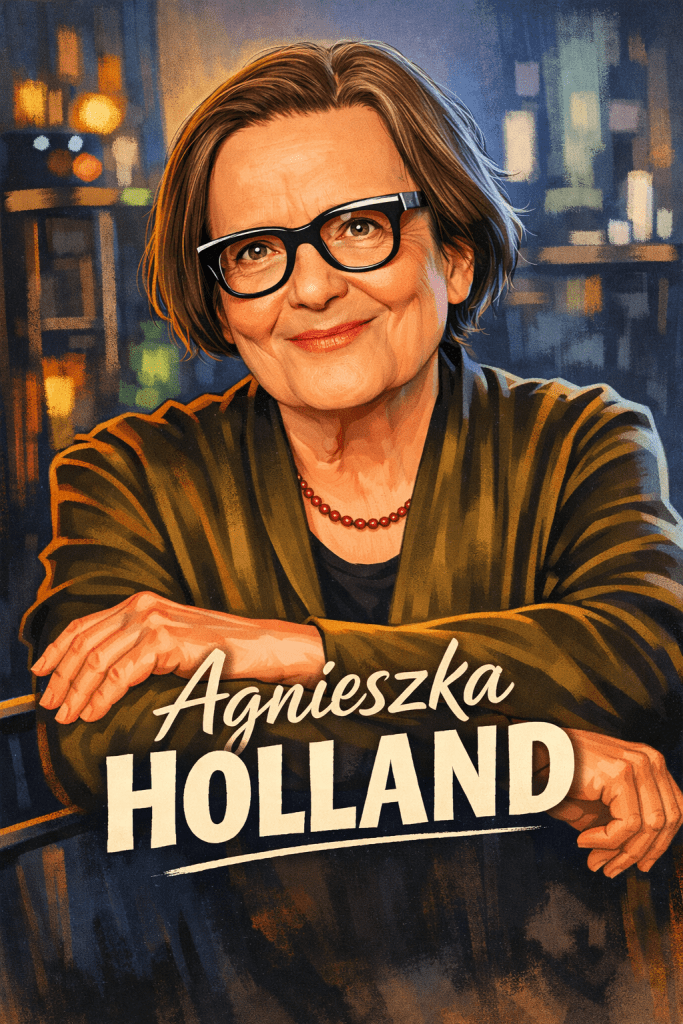
Holland emerged from the Central European cinematic tradition shaped by censorship, exile, and ideological pressure. Educated at FAMU in Prague, alongside filmmakers of the Czech New Wave, her early work in Poland was directly affected by political repression, pushing her into exile in the early 1980s. This experience would define her cinema: borders, displacement, and the violence of systems are never abstract in her films — they are embodied.
Her international breakthrough came with Europa Europa, a film that remains central to her legacy. Based on a true story, it explored identity under Nazism with a mixture of absurdity and terror, earning the Golden Globe for Best Foreign Language Film and an Academy Award nomination for Best Adapted Screenplay. The film established Holland’s ability to approach historical trauma without solemnity, exposing how survival often depends on moral compromise rather than heroism.
Throughout the 1990s and 2000s, Holland moved fluidly between European and American cinema, directing films such as The Secret Garden, Total Eclipse, and In Darkness, the latter earning an Academy Award nomination for Best International Feature Film. Even when working within more conventional narrative frameworks, her focus remained fixed on ethical tension, power asymmetry, and the limits of empathy.
Television became another crucial space for her political engagement. Holland directed key episodes of series such as The Wire, Treme, and House of Cards, bringing her sensitivity to institutional violence and moral decay into contemporary settings. Later, she co-created and directed Burning Bush, a landmark Czech series examining the aftermath of Jan Palach’s self-immolation, reinforcing her long-standing interest in how societies process political trauma.
Her recent work marks a return to direct, urgent confrontation with Europe’s present. Green Border stands as one of the most politically forceful films of the decade. Shot in stark black and white, it addresses the refugee crisis at the Polish-Belarusian border, exposing the machinery of dehumanisation operating at Europe’s margins. The film won the Special Jury Prize at the Venice Film Festival and became a focal point of political debate in Poland, underlining Holland’s refusal to separate cinema from civic responsibility. Its reception confirmed that her work has lost none of its capacity to provoke, unsettle, and intervene.
That same insistence on re-reading Europe’s moral landscape continues in her recent, widely discussed project Franz, Poland’s official submission for Best International Feature Film at the 98th Academy Awards (2026 Oscars), an unconventional biopic of Franz Kafka. Conceived as a kaleidoscopic mosaic rather than a linear life story, the film moves from Kafka’s youth in Prague to his death in 1924, blending biography, imagination, and the afterlife of cultural myth. Franz premiered at TIFF and competed in San Sebastián, confirming Holland’s ongoing interest in figures whose private fragility becomes inseparable from the political pressures of their time.
Across her career, Holland has received some of the most prestigious recognitions in international cinema: multiple awards at Berlin, Venice, and Cannes, European Film Awards, César nominations, and honorary distinctions recognising both her artistic and political impact. Yet awards have never softened her position. If anything, they have amplified her role as a filmmaker who uses visibility not for reassurance, but for confrontation.
What ultimately defines Agnieszka Holland’s cinema is not a signature style, but a moral insistence. Her films resist closure, refuse innocence, and challenge viewers to recognise how history reproduces itself through institutions, borders, and everyday compliance. In a cinematic landscape increasingly shaped by neutrality and speed, Holland’s work remains defiantly political — not as rhetoric, but as memory actively at work.
