
Few European actors have moved as effortlessly between arthouse cinema and global blockbusters as Mads Mikkelsen. Over the course of three decades, he has built a career defined not by versatility alone, but by an unusual ability to bring complexity, vulnerability, and restraint to characters who often exist at the edges of morality. Whether playing teachers, doctors, criminals, kings, or villains, Mikkelsen rarely seeks sympathy. Instead, he creates characters whose humanity emerges through ambiguity.
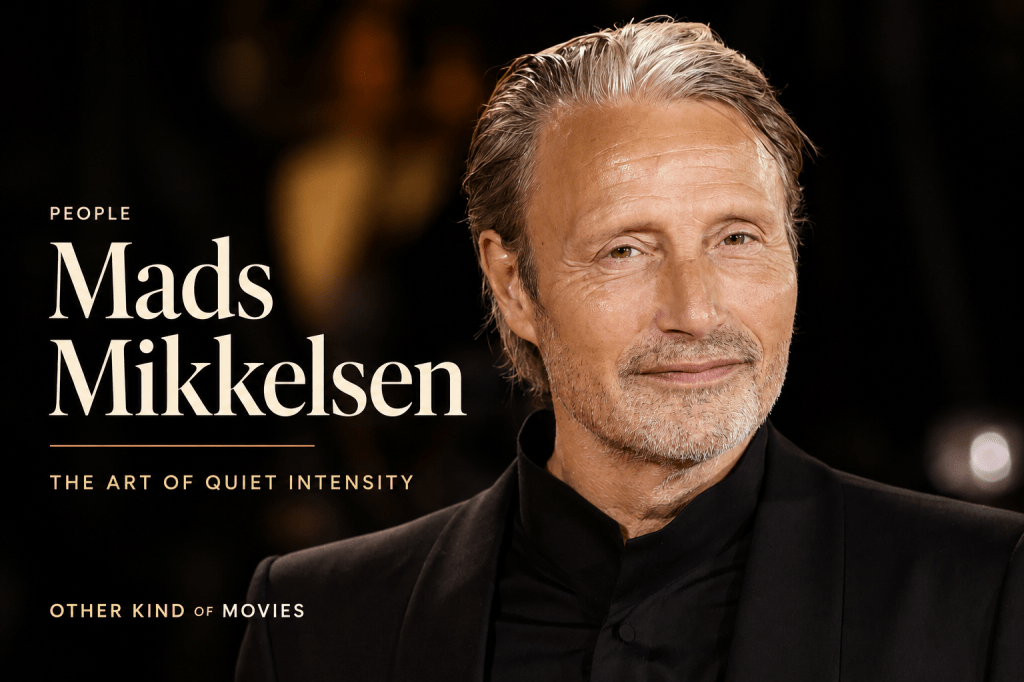
Before becoming one of Denmark’s most internationally recognised actors, Mikkelsen trained as a gymnast and dancer. His breakthrough came through Nicolas Winding Refn’s Pusher films, which helped define a new generation of Danish cinema and introduced audiences to his distinctive screen presence. Early performances in films such as Open Hearts, The Green Butchers, and After the Wedding quickly established him as one of the strongest actors working in Scandinavia.
International audiences first became familiar with him through blockbuster productions. As Le Chiffre in Casino Royale, he created one of the most memorable Bond villains of the modern era, a role that opened the door to Hollywood without ever pulling him away from European cinema. In the years that followed, he would appear in major franchises including Doctor Strange, Rogue One, Fantastic Beasts: The Secrets of Dumbledore, and Indiana Jones and the Dial of Destiny. Yet even at the height of his Hollywood visibility, his most acclaimed work continued to emerge from Europe.
That acclaim reached a new level with The Hunt, Thomas Vinterberg’s devastating drama about a man falsely accused of abuse. Mikkelsen’s performance earned him the Best Actor Award at the Cannes Film Festival, one of the most significant recognitions of his career. The role remains a masterclass in restraint, portraying humiliation, loneliness, and dignity without ever resorting to theatricality.
His collaboration with Vinterberg would produce another landmark with Another Round, in which he plays a teacher participating in an experiment involving constant low-level intoxication. The film became an international phenomenon, winning the Academy Award for Best International Feature Film, while Mikkelsen received the European Film Award for Best Actor and widespread critical acclaim. Its now-iconic final dance sequence revealed another dimension of his talent, reconnecting with his background as a dancer while encapsulating the film’s blend of melancholy and liberation.
More recently, Mikkelsen delivered one of the strongest performances of his career in The Promised Land (Bastarden), Nikolaj Arcel’s historical drama set in 18th-century Denmark. Playing Ludvig Kahlen, a former soldier determined to cultivate an unforgiving stretch of heathland, Mikkelsen anchors the film with a performance built on resilience, pride, and quiet determination. The role allows him to revisit the kind of morally complex characters that have defined much of his European work: individuals driven by ambition yet constantly confronted by forces larger than themselves. Widely praised by critics and selected as Denmark’s submission for the Academy Awards, The Promised Land reaffirmed Mikkelsen’s ability to carry an epic narrative without sacrificing emotional subtlety.
Television audiences know him equally well through Hannibal, where his portrayal of Hannibal Lecter became one of the most celebrated reinterpretations of an iconic character. Rather than imitating previous versions, Mikkelsen created a colder, more elegant, and unexpectedly seductive figure whose influence continues to resonate with audiences long after the series ended. The role transformed him into a cult figure while demonstrating his ability to balance menace and empathy within the same performance.
Awards have followed him throughout his career. Alongside his Cannes victory, Mikkelsen has received numerous Bodil and Robert Awards in Denmark, the European Film Academy’s Achievement in World Cinema Award, and countless international acting honours. Yet what makes his career remarkable is not the accumulation of trophies, but the consistency of his choices. He has repeatedly returned to films interested in moral uncertainty, social tension, and characters navigating situations that resist easy judgement.
What ultimately defines Mads Mikkelsen is his control. Few actors can communicate so much while appearing to do so little. A glance, a hesitation, a slight shift in posture — these become the foundations of performances that feel simultaneously precise and unpredictable. In a cinematic landscape often drawn to excess, Mikkelsen remains committed to understatement, proving that intensity does not require volume.
Whether leading an Oscar-winning Danish drama, embodying a television icon, or stealing scenes in a Hollywood blockbuster, Mads Mikkelsen continues to demonstrate why he is one of the most compelling actors working today. His career bridges continents, genres, and audiences, but its defining quality remains unchanged: a rare ability to make complexity feel effortless.
