
In recent decades, Chilean cinema has emerged as one of the most compelling voices in Latin America. Shaped by the country’s turbulent political history, striking landscapes and a new generation of fearless filmmakers, Chilean films often blur the boundaries between personal stories and broader social realities. Whether exploring dictatorship, identity, colonialism or the search for belonging, they consistently demonstrate an ability to combine emotional intimacy with sharp political insight.
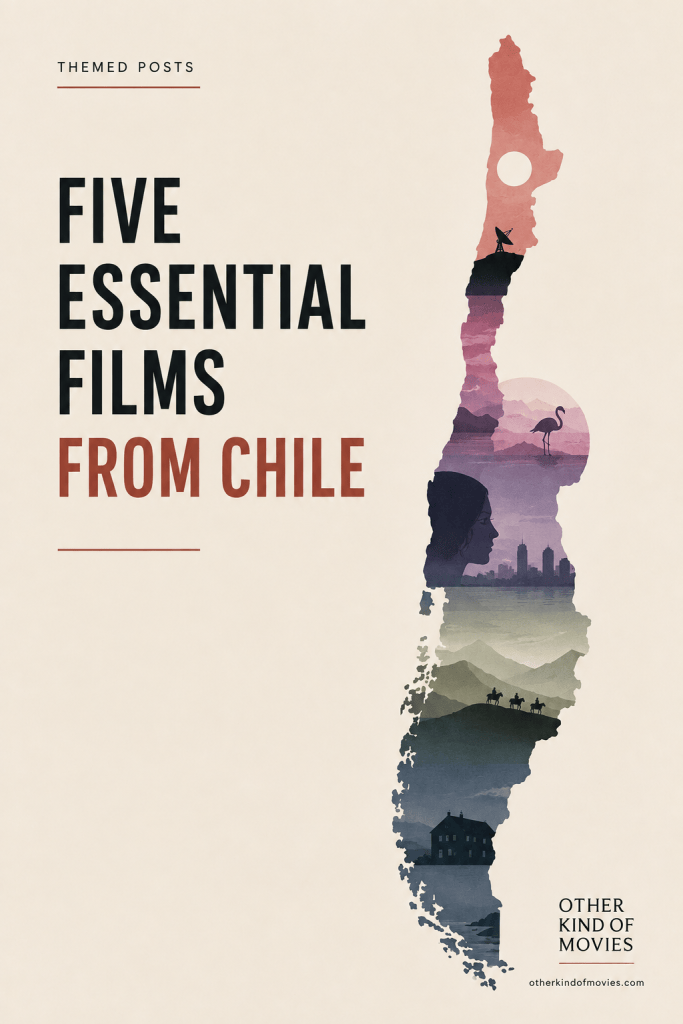
The five films below showcase the remarkable diversity of contemporary Chilean cinema. Spanning historical drama, LGBTQ+ stories, dark satire and revisionist westerns, they offer an excellent introduction to one of the most exciting national cinemas in the world.
No (2012)
Pablo Larraín’s acclaimed political drama recounts the historic 1988 referendum that marked the beginning of the end of Augusto Pinochet’s dictatorship. Rather than focusing on politicians, the film follows an advertising executive whose creative campaign transforms a democratic vote into an unprecedented media event.
Filmed using period television cameras, No seamlessly blends archival footage with newly shot material, creating an extraordinary sense of authenticity. More than a political thriller, it is a fascinating reflection on the power of images, marketing and optimism in shaping history. The film earned Chile its first-ever Academy Award nomination for Best Foreign Language Film, firmly establishing Larraín as one of the leading voices in contemporary world cinema.
The Mysterious Gaze of the Flamingo (2025)
One of the most exciting debuts in recent years, Diego Céspedes’ The Mysterious Gaze of the Flamingo transports viewers to a remote mining town in northern Chile during the early years of the AIDS crisis. Blending magical realism, queer cinema and elements of the western, the film creates an unforgettable atmosphere where myth, fear and desire become inseparable.
Winner of the Un Certain Regard Prize at the 2025 Cannes Film Festival, the film was also selected as Chile’s official submission for the 2026 Academy Awards, confirming Céspedes as one of the country’s most promising new filmmakers. It is a visually striking and emotionally fearless work that expands the boundaries of contemporary Chilean cinema.
A Fantastic Woman (2017)
Few films have had a greater international impact on Chilean cinema than Sebastián Lelio’s A Fantastic Woman. Centered on Marina, a transgender woman forced to confront prejudice following the sudden death of her partner, the film combines intimate character study with a powerful exploration of dignity, grief and resilience.
Daniela Vega delivers a remarkable leading performance that became a landmark for transgender representation in international cinema. The film went on to win the Academy Award for Best Foreign Language Film, giving Chile its first Oscar victory and cementing its place as one of the defining films of the decade.
The Settlers (2023)
Felipe Gálvez’s astonishing debut revisits the colonisation of Patagonia through the lens of a revisionist western. Set at the beginning of the twentieth century, the film follows an expedition across southern Chile that gradually reveals the brutal violence behind the country’s territorial expansion.
Rather than celebrating frontier mythology, The Settlers dismantles it, confronting the genocide of Indigenous peoples with unflinching honesty. Premiering in the Un Certain Regard section at Cannes, the film announced Gálvez as another major talent in Chile’s flourishing film industry while demonstrating that historical cinema can still challenge established national narratives.
The Club (2015)
Pablo Larraín appears once again with one of the darkest and most unsettling films of his career. Set inside an isolated coastal house where disgraced Catholic priests live in seclusion, The Club examines institutional silence, guilt and complicity with extraordinary restraint.
Avoiding sensationalism, Larraín constructs an atmosphere of constant unease in which moral ambiguity replaces easy judgement. Winner of the Silver Bear Grand Jury Prize at the Berlin International Film Festival, The Club remains one of the most incisive examinations of institutional power produced in recent years.
What unites these five films is not simply their country of origin but their willingness to confront difficult questions. Chilean cinema rarely offers comforting conclusions. Instead, it challenges audiences to reconsider history, identity, memory and justice through stories that are both deeply local and universally resonant.
From internationally celebrated masterpieces like A Fantastic Woman and No to bold recent works such as The Mysterious Gaze of the Flamingo and The Settlers, Chile continues to produce films that deserve a place among the finest achievements of contemporary world cinema. For anyone looking to explore South American filmmaking beyond the obvious classics, these five titles provide the perfect place to begin.
