
In an international festival calendar dominated by awards, red carpets and the race for prestigious trophies, the New York Film Festival occupies a rather unusual position. It does not award a Golden Lion, a Palme d’Or or a Golden Bear. There is no jury deciding which film deserves to stand above the others. Instead, its reputation rests on something equally valuable: the quality of its selection.
The 64th New York Film Festival, held from 25 September to 12 October 2026, once again brought some of the year’s most significant international films to Lincoln Center. Organised by Film at Lincoln Center, the event presented 119 films — 75 features and 44 shorts — from 46 countries, combining internationally established filmmakers, emerging voices, documentaries, experimental cinema and restored classics.
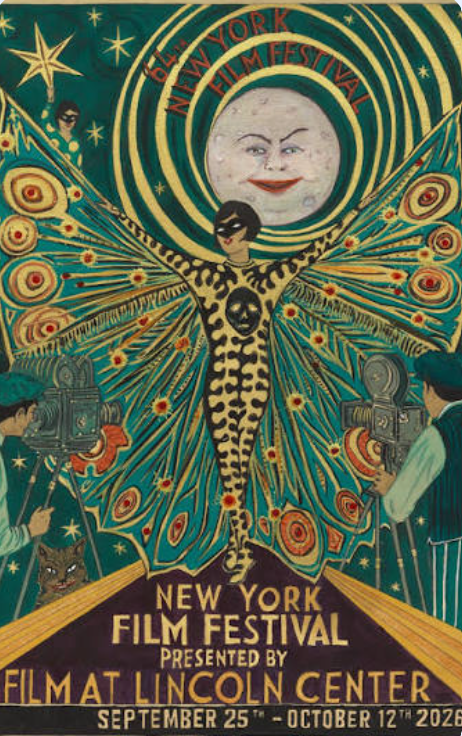
This year’s programme was particularly impressive. New works by James Gray, Pedro Almodóvar, Ryûsuke Hamaguchi, Mike Leigh, Lee Chang-dong, Hong Sangsoo, Paweł Pawlikowski and Luca Guadagnino appeared alongside films from directors whose names are still unfamiliar to much of the international audience.
The festival brings together films that have already generated attention in Cannes, Venice, Berlin or Toronto, while offering an important platform to works that may struggle to find widespread theatrical distribution.
And in 2026, the festival demonstrated once again that a carefully curated programme can be just as interesting as a list of winners.
The three headline selections revealed the breadth of the festival’s ambitions.
James Gray’s Paper Tiger opened the event with a return to the filmmaker’s native New York. Set in Queens and Brooklyn in 1986, the film follows a man whose relationship with his brother draws him into a dangerous criminal situation. With Adam Driver, Miles Teller and Scarlett Johansson leading the cast, the film continued Gray’s interest in family relationships, social ambition and the darker corners of the American experience.
Gray has maintained a particularly close relationship with the New York Film Festival, having previously presented The Immigrant, The Lost City of Z and Armageddon Time. His selection as the opening-night filmmaker therefore felt appropriate for an event so deeply connected to the city’s cinematic identity.
The festival’s Centerpiece Gala belonged to Tony Gilroy’s Behemoth!, which received its world premiere on 2 October.
Starring Pedro Pascal as Alex, a talented cellist struggling with the consequences of a fractured personal and professional life, the film marked Gilroy’s return to feature directing after more than a decade. Its supporting cast includes Olivia Wilde, and its focus on music, family expectations and emotional disappointment suggested a considerably more intimate project than the political thrillers and large-scale productions with which Gilroy is frequently associated.
For the closing-night selection, New York turned to Ava DuVernay.
Her documentary 14th arrived exactly ten years after 13th, the acclaimed film in which she examined the relationship between the abolition of slavery, the American prison system and racial inequality. This new work considers the historical significance and contemporary interpretation of the Fourteenth Amendment, particularly questions of citizenship, equality and constitutional protection.
The choice gave the festival a distinctly political conclusion and reinforced New York’s long-standing commitment to documentary filmmaking that engages with the major debates of its time.
The Main Slate – A Meeting Point for World Cinema
The heart of the New York Film Festival has always been its Main Slate, a carefully selected collection of films intended to reflect the most compelling developments in contemporary cinema.
In 2026, the section featured 34 films from 31 countries, including 17 directors making their Main Slate debut. Four films received world premieres, while others arrived following screenings at some of the world’s most important festivals.
The presence of several major international filmmakers was particularly striking.
All of a Sudden, by Japanese director Ryûsuke Hamaguchi, continued the filmmaker’s exploration of human relationships, emotional complexity and the ways ordinary conversations can reveal profound truths. Following the international success of Drive My Car and Evil Does Not Exist, Hamaguchi has become one of the most closely followed voices in contemporary Japanese cinema.
Another major Japanese filmmaker, Hong Sangsoo, appeared twice in the programme with The Day She Returns and Nowhere to Lay My Eyes. His presence reinforced a longstanding connection with New York, where his intimate, dialogue-driven films have consistently found an appreciative audience.
South Korean cinema was also represented by Lee Chang-dong‘s Possible Love. The director of Burning, Poetry and Secret Sunshine remains one of the most respected filmmakers working in Asia, making his latest film an especially noteworthy inclusion.
European cinema occupied an equally prominent position. Pedro Almodóvar presented Bitter Christmas, while Mike Leigh brought Tender Loving Care, the film that had recently won the Golden Shell at the San Sebastián International Film Festival.
Their inclusion demonstrated how the New York Film Festival often serves as a meeting point for films that have already established reputations elsewhere.
Paweł Pawlikowski’s Fatherland, Andrew Haigh’s A Long Winter, Andrey Zvyagintsev’s Minotaur and Markus Schleinzer’s Rose added further depth to the European selection, offering very different approaches to personal, historical and social storytelling.
Meanwhile, Luca Guadagnino’s Artificial received its world premiere. Starring Andrew Garfield, Yura Borisov and Mark Rylance, the film examines the development of artificial intelligence through the people and institutions involved in its rapid expansion. Its inclusion reflected the festival’s willingness to engage with subjects extending beyond traditional cinematic territory.
Among the most distinctive selections was Once Upon a Time in Harlem, directed by William Greaves and completed by his son David Greaves. Built around footage recorded in 1972, when William Greaves brought together prominent figures associated with the Harlem Renaissance, the documentary offered an extraordinary encounter between cinema, cultural memory and African American history.
It was a reminder that a film’s significance does not always depend on how recently its images were captured. Sometimes cinema’s greatest discoveries come from material that has been waiting decades to be seen.
Spotlight – From Godzilla to Werner Herzog
The Spotlight section offered a somewhat different experience from the Main Slate, combining high-profile premieres with documentaries, genre cinema and unusual artistic projects.
Its most spectacular presentation was undoubtedly the world premiere of Godzilla Minus Zero, directed by Takashi Yamazaki.
Following the enormous international success of Godzilla Minus One, Yamazaki returned to post-war Japan with a sequel continuing the story of the Shikishima family. The film’s selection as the Spotlight Gala demonstrated that New York’s definition of significant cinema is not restricted to independent dramas or established arthouse traditions.
Other selections were considerably more unconventional.
Werner Herzog returned with Bucking Fastard, while Paul Thomas Anderson presented Cameron Winter at Carnegie Hall, a concert film capturing the musician’s performance at the famous New York venue.
Jonathan Glazer, director of The Zone of Interest, contributed Joy of Joys, a documentary developed in collaboration with composer Mica Levi around the recording of a charity album.
The section also included films by Cristian Mungiu, Albert Serra and Jesse Eisenberg, demonstrating the range of artistic approaches represented beyond the principal programme.
This diversity is important. A festival devoted exclusively to serious dramas risks presenting an unnecessarily narrow understanding of cinematic achievement. New York’s willingness to place a major Japanese monster film alongside experimental documentaries and concert films suggests a much more inclusive conception of what cinema can accomplish.
Currents and Revivals – Looking Forward and Backwards
Two sections deserve particular attention because they reveal something essential about the identity of the New York Film Festival.
The first is Currents, dedicated to adventurous filmmaking that challenges established narrative and visual conventions.
In 2026, Currents included 15 feature films and 28 shorts, with contributions from filmmakers working across different countries, formats and artistic traditions.
For audiences willing to venture beyond familiar cinematic structures, this is arguably one of the festival’s most exciting sections. Its films often explore the boundaries between documentary and fiction, experiment with editing and sound, or challenge the expectations viewers bring to the screen.
The second is Revivals, a section devoted to film restoration and preservation.
This year, its programme included newly restored versions of Ken Russell’s The Devils and Michael Powell and Emeric Pressburger’s Gone to Earth.
The restoration of Gone to Earth was particularly significant because the original film had been extensively altered following its initial release. The new restoration, overseen by Martin Scorsese and Thelma Schoonmaker, offered audiences an opportunity to rediscover the filmmakers’ original vision.
The section also featured a restoration of Barbara Hammer’s Nitrate Kisses, an important work of queer experimental cinema.
There is something especially valuable about placing these films alongside contemporary premieres.
Cinema does not develop in isolation. Every new generation builds upon the artistic discoveries, experiments and achievements of those who came before. Restoring older works ensures that those connections remain visible.
A Festival Without Winners
Perhaps the most distinctive aspect of the New York Film Festival is what happens when the screenings end.
There are no competitive awards.
Unlike Cannes, Venice, Berlin or San Sebastián, the festival does not conclude with a ceremony announcing the year’s best film, director or performance.
That absence changes the way the event is experienced.
Without a competition, the attention remains on the films themselves. A modest independent production does not need to compete for recognition against a major international premiere. A documentary can occupy the same cultural space as a fictional drama. An experimental short can be discussed alongside the latest work of an internationally celebrated director.
Of course, the festival is not entirely removed from the wider awards season. Many films arrive in New York with reputations already established elsewhere, while others are preparing for theatrical releases and potential Oscar campaigns.
But the festival’s own identity is built around selection, discovery and discussion.
That makes it a particularly interesting event to follow from outside the United States.
New York as a Window onto International Cinema
The 64th New York Film Festival offered an impressive overview of contemporary filmmaking.
From James Gray’s New York crime drama to Ava DuVernay’s constitutional documentary, from Ryûsuke Hamaguchi and Lee Chang-dong to Pedro Almodóvar and Mike Leigh, the programme crossed national, linguistic and stylistic boundaries with remarkable ease.
Its more adventurous sections expanded that range further, while the restorations reminded audiences that the history of cinema remains an essential part of its present.
What makes the New York Film Festival so appealing is not simply the number of celebrated directors appearing in its programme. It is the possibility of discovering something unexpected between those familiar names.
A film from a country rarely represented in international cinemas. A documentary assembled from forgotten archival material. An experimental work that challenges the very definition of storytelling. Or a restored classic that suddenly feels as relevant as anything produced today.
The New York Film Festival does not need to tell audiences which film is the best. Its greater achievement is bringing together films that remind us how many different things cinema can be.
And for anyone interested in discovering cinema beyond the obvious choices, that is a compelling reason to keep following it.
For the complete programme, filmmaker conversations and further information, visit the official New York Film Festival website.
