
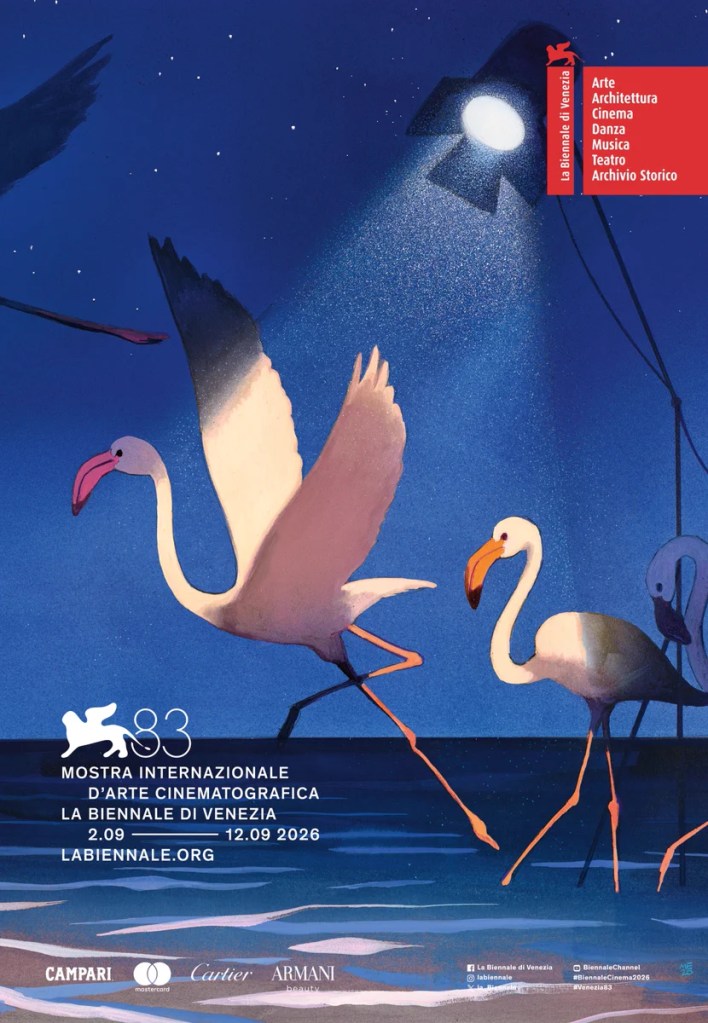
Few film festivals combine history, glamour and cinematic discovery quite like Venice. The 83rd Venice International Film Festival, held on the Lido from 2 to 12 September 2026, once again brought together established auteurs, emerging filmmakers and some of the year’s most anticipated films. Yet this year’s edition felt particularly engaged with the world beyond the red carpet, with a programme that repeatedly confronted war, inequality, political power and social division.
Organised by La Biennale di Venezia and directed by Alberto Barbera, the festival presented 21 films in the main Venezia 83 competition, judged by a jury chaired by Maggie Gyllenhaal and including Kaouther Ben Hania, Daniel Blumberg, Francesco Casetti, Xavier Giannoli, Shahrbanoo Sadat and Johnnie To. Alongside the main competition, Venice’s extensive programme included Orizzonti, Venice Spotlight, Venice Classics, Biennale College Cinema and Venice Immersive.
The Main Awards
The festival’s highest honour went to Danish-Egyptian director May el-Toukhy, whose Woman Unknown received the Golden Lion for Best Film. The drama also brought Mathilde Arcel the Volpi Cup for Best Actress, making it the most prominent double winner of the main competition.
Lee Chang-dong returned to international cinema with Possible Love, which received the Silver Lion – Grand Jury Prize. The South Korean filmmaker’s exploration of two married couples from different social classes marked another major achievement in a career that has produced films including Burning, Poetry and Secret Sunshine.
The Silver Lion for Best Director went to Ilya Khrzhanovsky for DAU, while the Special Jury Prize was awarded to NAZA, directed by Yuval Abraham and Rachel Szor, two of the filmmakers behind No Other Land. NAZA became one of the festival’s most discussed documentaries, examining the war in Gaza and receiving an extraordinary response at its Venice premiere.
The principal Venezia 83 awards were:
| Award | Winner |
|---|---|
| Golden Lion – Best Film | Woman Unknown — May el-Toukhy |
| Silver Lion – Grand Jury Prize | Possible Love — Lee Chang-dong |
| Silver Lion – Best Director | Ilya Khrzhanovsky — DAU |
| Volpi Cup – Best Actress | Mathilde Arcel — Woman Unknown |
| Volpi Cup – Best Actor | John Malkovich — Wild Horse Nine |
| Best Screenplay | Stéphane Brizé, Coralie Amédéo & Olivier Gorce — A Good Little Soldier |
| Special Jury Prize | NAZA — Yuval Abraham & Rachel Szor |
| Marcello Mastroianni Award | Malou Khebizi — A Place to Heal |
John Malkovich and Wild Horse Nine
Among the festival’s major acting stories was John Malkovich, who received the Volpi Cup for Best Actor for Martin McDonagh’s Wild Horse Nine. The film, a UK-US-Chilean co-production, generated considerable attention at the Lido and received a lengthy standing ovation following its premiere. Malkovich’s performance as an eccentric CIA agent became one of the most widely discussed of the festival.
It was an especially significant edition for Malkovich, who had also recently been honoured at Telluride. More than four decades into his screen career, Venice provided another reminder of his ability to remain unpredictable in the roles he chooses.
A Particularly Political Edition
Beyond individual films and performances, the defining characteristic of Venice 2026 may have been the unusually political nature of its selection. Barbera himself described the line-up as the festival’s “most political ever”, with films examining subjects ranging from Gaza and immigration enforcement to media power, Russia and the influence of technology billionaires.
That atmosphere extended beyond the films themselves. Political questions repeatedly entered press conferences and conversations around the festival, while jury president Maggie Gyllenhaal argued that cinema is inherently connected to politics and the societies from which stories emerge.
At the same time, Venice retained the star power that has increasingly made it one of the essential opening events of the autumn film season. Javier Bardem and Penélope Cruz appeared with Bunker, Robert Pattinson with Primetime, while Martin McDonagh’s Wild Horse Nine brought Malkovich and Sam Rockwell to one of the festival’s most enthusiastically received premieres.
Orizzonti and New Voices
Away from the main competition, Orizzonti once again provided an important platform for filmmakers experimenting with new approaches to contemporary cinema.
The Best Film award went to Belgian-French production Diane in the Loop by Ann Sirot and Raphaël Balboni, while Greek filmmaker Jacqueline Lentzou received Best Director for A Day in the Life of Jo: Chapter Phaedra. Laleh Marzban won Best Actress for Iranian drama Falling House, and Riccardo Scamarcio received Best Actor for The Children of the Monkey.
Particularly notable was Auguste Bernard Kouemo Yanghu’s House of the Wind, which received the Orizzonti Special Jury Prize before also winning the Lion of the Future – Luigi De Laurentiis Award for a Debut Film. The Cameroon-led international co-production therefore emerged as one of the discoveries of the 2026 festival.
Celebrating Cinema’s Past and Present
Venice also used its 83rd edition to celebrate careers that have left a lasting mark on cinema. Ellen Burstyn was honoured with a Golden Lion for Lifetime Achievement, while the festival also recognised Luca Guadagnino with the Cartier Glory to the Filmmaker Award.
The Venice Classics section continued the festival’s commitment to film preservation, awarding Best Restored Film to Florestano Vancini’s Long Night of 1943. It is an aspect of Venice that can sometimes be overshadowed by premieres and celebrities but remains essential to the festival’s identity: looking towards cinema’s future while continuing to rediscover its past.
Another Memorable Year on the Lido
The 2026 edition ultimately demonstrated why Venice remains such an important meeting point for international cinema. Its programme moved comfortably between major stars and emerging filmmakers, fiction and documentary, political urgency and intimate human stories. Audience interest was also particularly strong: the festival reported 117,656 tickets sold, 14% more than in the record-setting 2025 edition.
With Woman Unknown taking the Golden Lion, Possible Love confirming Lee Chang-dong’s return as a major cinematic event, and films such as NAZA, Wild Horse Nine and House of the Wind emerging among the edition’s most notable titles, Venice 2026 offered far more than the glamour traditionally associated with the Lido. At 83 editions and counting, the world’s oldest film festival remains an essential place to discover where international cinema is heading next.
For the complete programme, awards and information about the festival, visit the official Venice International Film Festival website.
