Watching Saleh Bakri over the past few years has been one of the quiet pleasures of following international cinema. Film after film, he has appeared in projects worth seeking out: Costa Brava, Lebanon, The Blue Caftan, The Teacher, All That’s Left of You and Palestine 36. Different countries, different directors and very different characters, yet Bakri has become a remarkably reliable presence within them.
For those who have followed Palestinian and Arab cinema for longer, this is hardly an overnight success. Bakri had already spent well over a decade building an impressive career before this recent sequence of films. But there is something particularly exciting about the stage he has reached now. At 49, he seems to have found the combination of maturity, experience and choice of projects that allows an actor to turn an already respected career into something more substantial.
And increasingly, seeing Saleh Bakri’s name in a cast is itself a reason to pay attention.
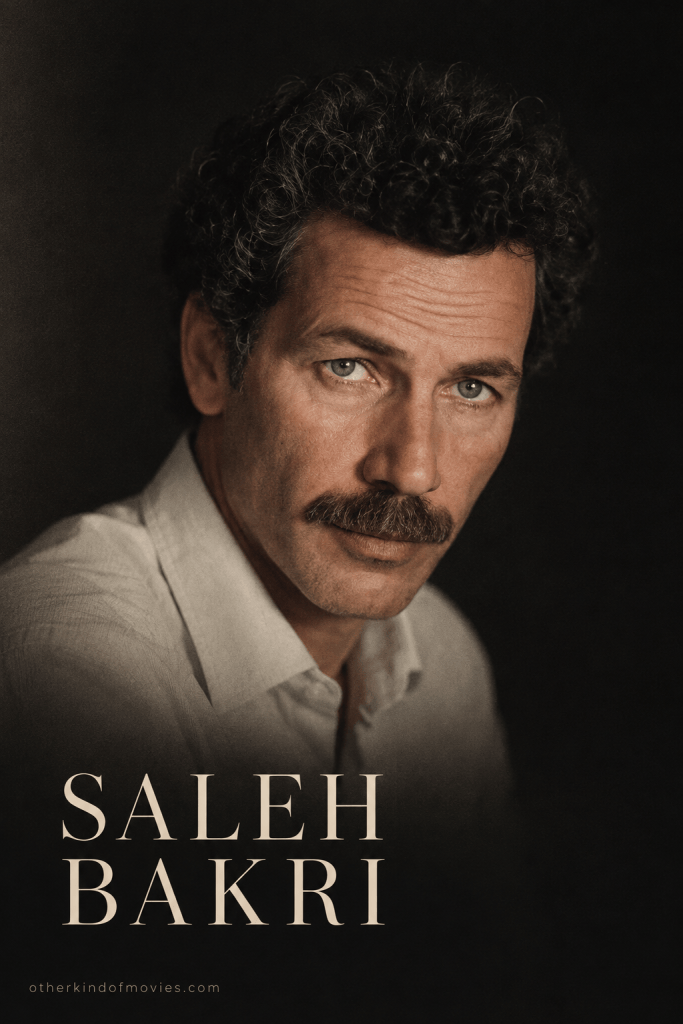
Born in Jaffa in 1977, Bakri grew up surrounded by theatre and cinema. His father, the late Mohammad Bakri, was one of the major figures of Palestinian acting and filmmaking, while his brothers Adam and Ziad also became actors. Saleh’s own artistic beginnings were rooted in theatre before cinema gradually became the most internationally visible part of his career.
His breakthrough came in 2007 with The Band’s Visit, Eran Kolirin’s acclaimed comedy-drama about an Egyptian police orchestra stranded in a small Israeli town. Bakri played Khaled, the younger member of the band, and immediately attracted attention. The role earned him the Israeli Film Academy Award for Best Supporting Actor and the Wolgin Award for Most Promising Actor at the Jerusalem Film Festival.
His arrival in cinema coincided with another collaboration that would prove even more significant. Annemarie Jacir cast him in her first feature, Salt of This Sea, which premiered at Cannes in 2008 and became Palestine’s submission for the Academy Awards. Bakri would subsequently work with Jacir on When I Saw You, Wajib and, many years later, Palestine 36.
Those early films already established an important characteristic of his career: Bakri was interested in Palestinian stories but never limited himself to a single cinematic tradition.
He worked with Elia Suleiman in The Time That Remains, appeared alongside Hiam Abbass and Leïla Bekhti in Radu Mihăileanu’s The Source, and travelled into Italian genre cinema with Salvo in 2013. In the latter, he played a Sicilian Mafia hitman in a film that went on to win the Grand Prix and France 4 Visionary Award at Cannes Critics’ Week.
By then, Bakri had already demonstrated something that has become increasingly apparent with time: his acting travels remarkably well.
One of the defining films of Bakri’s career arrived in 2017 when he reunited with Jacir for Wajib.
He plays Shadi, an architect living abroad who returns to Nazareth and spends a day driving around the city with his father, Abu Shadi, personally delivering invitations for his sister’s wedding. The casting gives the film an additional layer: Abu Shadi is played by Mohammad Bakri, Saleh’s real-life father.
There is very little conventional drama in the premise, but that is precisely what makes the performances so effective. The conversations inside the car gradually expose political disagreements, generational tensions, different attitudes towards Palestine and the complicated affection between a father and son who understand each other perhaps less than either would like.
Saleh Bakri’s performance is beautifully measured. Shadi’s frustration is visible long before he articulates it, but so is his affection for his father.
The role earned Bakri the Muhr Award for Best Actor at the Dubai International Film Festival, shared with Mohammad Bakri, and a nomination for Best Performance by an Actor at the Asia Pacific Screen Awards.
Looking back, Wajib also feels like an important bridge between the first part of his career and the actor Bakri has become today.
A Remarkable Run of Films
Something changed around the beginning of the 2020s. Not necessarily in Bakri’s acting — the talent had long been evident — but in the consistency of the films surrounding him.
Farah Nabulsi’s short The Present (2020) was an important turning point. Bakri plays a Palestinian father attempting to buy an anniversary present with his daughter, an apparently ordinary journey transformed by the realities of checkpoints and restricted movement in the West Bank. The film was nominated for the Academy Award for Best Live Action Short Film, while Bakri received several acting prizes for his performance.
Then came Mounia Akl’s Costa Brava, Lebanon (2021), with Bakri playing the father of a family that has attempted to escape the pollution and dysfunction of Beirut by retreating to an isolated home in the mountains. It is a fascinating role because his character’s idealism is intertwined with stubbornness and control. Bakri received a Best Actor award at Morocco’s Salé International Women’s Film Festival for the performance.
A year later, Maryam Touzani’s The Blue Caftan gave him one of his most delicate roles.
As Halim, a traditional Moroccan tailor living with his wife while privately suppressing his attraction to men, Bakri gives a performance almost entirely dependent on emotional precision. Desire, affection, fear and repression coexist without being explained to the audience. The way Halim touches fabric, works on an embroidery or looks at another person becomes part of the character’s emotional vocabulary.
It is difficult to imagine The Blue Caftan having quite the same tenderness without him.
And then came The Teacher.
Farah Nabulsi reunited with Bakri for her feature debut, casting him as Basem, a Palestinian schoolteacher in the West Bank carrying the weight of personal tragedy while becoming increasingly involved in the life of one of his students.
For me, it is one of the clearest examples of how much Bakri has grown as an actor.
There is anger throughout the performance, but Bakri rarely plays the anger itself. Basem attempts to contain it. His authority as a teacher, his relationship with his student and his personal grief all depend upon a man trying to maintain control over emotions that are constantly threatening to escape.
That restraint makes the moments when his defences weaken considerably more powerful.
The performance brought Bakri one of the most significant individual awards of his career: Best Actor at the 2023 Red Sea International Film Festival. The festival jury also awarded The Teacher its Jury Prize.
By this point, the pattern was becoming difficult to ignore. Bakri was not simply appearing regularly; he was repeatedly choosing films with something substantial to say.
That run has continued with two of the most ambitious Palestinian films of recent years.
Cherien Dabis’s All That’s Left of You (2025) places Bakri inside a multigenerational Palestinian family story extending across decades. He plays Salim, part of a narrative in which personal memory and Palestinian history become inseparable. The film’s ensemble is particularly meaningful because it includes several members of the Bakri family: Saleh appears alongside his father Mohammad and his brother Adam.
Then came Palestine 36, bringing him back to Annemarie Jacir almost two decades after Salt of This Sea.
Set during the 1936–1939 Arab Revolt against British rule in Mandatory Palestine, the film expands Jacir’s cinema onto a much larger historical canvas. Bakri plays Khalid as part of an ensemble that also includes Hiam Abbass, Kamel El Basha, Yasmine Al Massri and Jeremy Irons. The film premiered at the Toronto International Film Festival in 2025 and was subsequently selected as Palestine’s submission for the Academy Award for Best International Feature.
There is something fitting about Bakri appearing in the film. His collaboration with Jacir has now accompanied a substantial part of both of their careers, moving from contemporary Palestinian displacement in Salt of This Sea to the intimate family tensions of Wajib and eventually towards the historical origins explored in Palestine 36.
The Best Years of His Career?
Saleh Bakri has been a respected actor for nearly twenty years, so describing his current success as a breakthrough would be misleading. His early career already included Cannes premieres, major festival films and award-winning performances.
What has changed is the concentration of exceptional work.
Consider the sequence: The Present, Costa Brava, Lebanon, The Blue Caftan, The Teacher, All That’s Left of You and Palestine 36. Few actors working in contemporary Arab cinema have assembled such a consistent collection of films over the same period.
There is also an appealing lack of vanity in the way Bakri performs. He does not seem particularly interested in making a character likeable or ensuring that the audience notices the acting. His strongest performances often depend on contradiction: tenderness beside anger, authority alongside vulnerability, love complicated by resentment or desire restricted by social expectations.
Perhaps that is why he has become such a natural collaborator for filmmakers like Annemarie Jacir, Farah Nabulsi, Maryam Touzani, Mounia Akl and Cherien Dabis. Their films ask the audience to observe people rather than simply categorise them.
At 49, Bakri appears to be entering an especially interesting phase of his career. He has the experience of an actor who has worked across theatre, Palestinian cinema and international productions, while his recent choices suggest an artist increasingly comfortable taking on complex characters in ambitious films.
For anyone interested in contemporary world cinema, his filmography has quietly become one worth following.
And after the extraordinary run he has had over the past few years, whatever Saleh Bakri chooses next deserves our attention.