
Animals have always occupied a fascinating place in cinema. Sometimes they appear as companions, sometimes as threats, and occasionally as symbols of the qualities we associate with ourselves. Their presence can evoke innocence, danger, freedom, vulnerability or survival, even when the animals themselves never appear on screen.
But what happens when an animal becomes part of a film’s title?
In some cases, the connection is immediately apparent. In others, the animal functions as a metaphor, suggesting something about a character, a society or the world the filmmaker wants to explore.
The following five films come from remarkably different cinematic traditions, taking us from the streets of Iran to rural Chile, from Indigenous mythology in Hungary to Nazi Germany and contemporary London.
What unites them is not simply the presence of an animal in their titles, but the way these references open the door to stories about prejudice, identity, violence, belonging and the struggle to survive.
1. Holy Spider (Denmark, 2022)
Director: Ali Abbasi
In the Iranian holy city of Mashhad, a series of murders targeting sex workers spreads fear through the streets. As the authorities appear reluctant to pursue the investigation with sufficient determination, journalist Rahimi arrives from Tehran to uncover the truth.
Her investigation leads her into a deeply conservative environment where religious convictions, institutional indifference and widespread misogyny complicate the search for justice.
Inspired by the real-life crimes of serial killer Saeed Hanaei, Holy Spider is a disturbing thriller that examines how violence against women can be justified or tolerated within certain social structures.
Zar Amir Ebrahimi, who won the Best Actress Award at the 2022 Cannes Film Festival, delivers an extraordinary performance as Rahimi. Her character must navigate a society in which being a woman investigating crimes against other women places her in constant danger.
Director Ali Abbasi constructs an oppressive atmosphere, moving between the journalist’s investigation and the killer’s everyday existence. This narrative approach makes the film particularly unsettling, revealing how extraordinary brutality can coexist with seemingly ordinary family life.
The spider of the title evokes a predator constructing a web around its victims. But it also suggests something larger: a network of beliefs, prejudices and institutions that allows violence to continue.
The film’s most troubling achievement lies in its refusal to present the murderer as an isolated aberration. Instead, it asks how an entire society can contribute to the conditions that make such crimes possible.
Holy Spider is not an easy film to watch, but its uncompromising examination of misogyny and moral hypocrisy makes it one of the most powerful Iranian-set thrillers of recent years.
2. The Mysterious Gaze of the Flamingo (Chile, 2025)
Director: Diego Céspedes
Set in a remote Chilean mining town during the early 1980s, The Mysterious Gaze of the Flamingo introduces us to a small community of transgender women and gay men who have created an unconventional family in an environment marked by isolation and prejudice.
At the centre of the story is Lidia, an eleven-year-old girl growing up among these characters, whose lives become increasingly threatened when a mysterious illness begins spreading through the region.
As fear takes hold, local residents start blaming the community for the disease, claiming that it can be transmitted through a simple gaze.
Through Lidia’s perspective, director Diego Céspedes explores the devastating consequences of ignorance and discrimination while celebrating the affection and solidarity that can exist among people excluded from mainstream society.
The film draws inspiration from the early years of the AIDS crisis, when misinformation and prejudice frequently transformed already marginalised communities into targets of collective suspicion.
Yet The Mysterious Gaze of the Flamingo is far from being exclusively a story about suffering.
Its characters display humour, tenderness and remarkable resilience, creating a world in which chosen families offer protection against the hostility of the outside environment.
Céspedes combines elements of melodrama, magical realism and queer cinema, giving the film a distinctive emotional and visual identity.
The flamingo of the title is particularly evocative. With its striking appearance and unmistakable elegance, the bird becomes an appropriate symbol for a story about individuals whose visibility makes them both extraordinary and vulnerable.
The film received the Un Certain Regard Prize at the 2025 Cannes Film Festival, marking an impressive achievement for Céspedes’s feature debut.
Beneath its unusual premise lies a deeply moving reflection on the importance of belonging, particularly for those whose identities are treated as unacceptable by the societies around them.
3. Four Souls of Coyote (Hungary, 2023)
Director: Áron Gauder
Animation offers filmmakers extraordinary freedom to explore mythology, cultural identity and the relationship between humanity and the natural world.
In Four Souls of Coyote, Hungarian director Áron Gauder uses that freedom to create a visually imaginative film inspired by Indigenous North American creation stories.
The narrative begins in the present day, where a group of Indigenous activists protests against the construction of an oil pipeline threatening their ancestral lands.
As tensions rise, an elder tells the younger protesters a traditional creation story involving the Great Creator and Coyote, a mischievous figure whose actions repeatedly disrupt the balance of the emerging world.
The film then transports viewers into a colourful mythological universe where animals, humans and natural forces are interconnected.
Coyote occupies a particularly interesting position within this narrative.
He is neither a conventional hero nor a straightforward villain. Curious, impulsive and frequently selfish, he makes decisions that produce unexpected consequences for the world around him.
His behaviour reflects the contradictions of human nature, particularly our tendency to place personal desires above the wellbeing of others.
Through this character, the film explores environmental destruction, greed and the fragile relationship between humanity and nature.
Gauder’s animation combines traditional visual influences with contemporary techniques, creating a distinctive aesthetic that moves between humour, spirituality and ecological reflection.
The film received the Jury Award at the 2023 Annecy International Animation Film Festival, one of the world’s most prestigious events dedicated to animation.
What makes Four Souls of Coyote especially interesting is its ability to connect ancient storytelling traditions with urgent contemporary concerns.
The struggle against the oil pipeline is not presented as an isolated environmental dispute, but as part of a much longer history of humanity’s relationship with the natural world.
Coyote, with all his flaws and contradictions, becomes a reflection of ourselves: intelligent enough to understand the world, yet frequently incapable of resisting the impulses that threaten to destroy it.
4. Jojo Rabbit (New Zealand, 2019)
Director: Taika Waititi
Few films approach the horrors of Nazism through comedy, and even fewer attempt to do so from the perspective of a child who enthusiastically embraces its ideology.
In Jojo Rabbit, director Taika Waititi introduces us to Johannes “Jojo” Betzler, a ten-year-old German boy growing up during the final years of the Second World War.
Jojo is an enthusiastic member of the Hitler Youth, convinced that loyalty to Nazi ideology will make him a brave and respected young man.
His imaginary friend is none other than Adolf Hitler, portrayed by Waititi himself as an absurd, childish and increasingly ridiculous figure.
Jojo’s worldview begins to unravel when he discovers that his mother, Rosie, played by Scarlett Johansson, is secretly hiding a Jewish teenage girl named Elsa in their home.
Initially terrified by everything he has been taught to believe, Jojo gradually begins questioning the prejudices that have shaped his understanding of the world.
Waititi combines satire, emotional drama and coming-of-age storytelling to explore how hatred is learned and how empathy can challenge even deeply rooted beliefs.
Roman Griffin Davis gives an impressive performance as Jojo, capturing both the innocence and the disturbing ideological enthusiasm of a child desperate to belong.
Thomasin McKenzie, as Elsa, provides an essential counterpoint, confronting Jojo’s prejudices with intelligence, patience and occasional humour.
The rabbit of the title refers to a nickname Jojo receives after refusing to kill a rabbit during a Hitler Youth training exercise.
Initially intended as an insult suggesting cowardice, the animal gradually acquires a different meaning.
Jojo’s reluctance to harm a defenceless creature reveals a compassion that conflicts with the cruelty demanded by the ideology he has embraced.
The film won the Academy Award for Best Adapted Screenplay and received six Oscar nominations, including Best Picture.
Although its combination of comedy and historical tragedy divided critics, Jojo Rabbit remains a distinctive examination of childhood indoctrination and the possibility of moral transformation.
Ultimately, the rabbit represents something much more valuable than courage as defined by a violent political movement: the ability to recognise vulnerability and respond with kindness.
5. Urchin (United Kingdom, 2025)
Director: Harris Dickinson
The final film in our selection takes us to contemporary London, far removed from the historical and mythological settings of the previous entries.
Urchin, the directorial debut of British actor Harris Dickinson, follows Mike, a young homeless man struggling with addiction, instability and the consequences of his own destructive behaviour.
Played by Frank Dillane, Mike moves through a city where opportunities for recovery exist but remain frustratingly difficult to sustain.
His encounters with social services, temporary accommodation and people willing to help him reveal both the possibilities and limitations of the systems designed to support individuals living on society’s margins.
Dickinson avoids presenting homelessness through an exclusively sentimental perspective.
Mike can be sympathetic, vulnerable and genuinely eager to change, but he can also be manipulative, impulsive and responsible for decisions that undermine his own progress.
This complexity is one of the film’s greatest strengths.
Rather than reducing its protagonist to an innocent victim of social circumstances, Urchin examines the difficult relationship between individual responsibility and structural disadvantage.
Frank Dillane delivers an intense and unpredictable performance, capturing the contradictions of a character who repeatedly struggles to reconcile his desire for stability with the impulses that threaten it.
The film also incorporates surreal and dreamlike sequences, suggesting the psychological disorientation experienced by someone whose life has become increasingly disconnected from conventional social structures.
Dickinson’s direction is confident and compassionate without becoming indulgent.
The title is particularly interesting because “urchin” has two meanings in English.
It can refer to a sea urchin, a small marine animal protected by sharp spines, but the word has also historically been used to describe a poor or neglected child living on the streets.
Both meanings resonate with the film’s protagonist.
Mike’s difficult behaviour can be understood partly as a defensive response to a world in which vulnerability frequently leads to exploitation or rejection.
Like a sea urchin, he appears to protect himself through characteristics that make approaching him difficult.
Urchin premiered in the Un Certain Regard section of the 2025 Cannes Film Festival, where Frank Dillane received the Best Actor Award and Dickinson won the FIPRESCI Prize.
The film represents an impressive debut from Dickinson, revealing a filmmaker interested in the complicated realities of contemporary urban life.
It is also a reminder that people living on society’s margins cannot be understood through simple categories of innocence, guilt, success or failure.
Sometimes, the very behaviours that make someone difficult to help are inseparable from the experiences that made that help necessary.
Five Animals, Five Ways of Looking at Humanity
At first glance, these five films have little in common.
Holy Spider examines misogyny and violence in Iran, while The Mysterious Gaze of the Flamingo explores prejudice and chosen families in Chile. Four Souls of Coyote uses Indigenous mythology to reflect on humanity’s relationship with nature, Jojo Rabbit challenges the absurdity of ideological indoctrination, and Urchin portrays the complexities of homelessness and addiction.
Yet the animals in their titles reveal an intriguing connection.
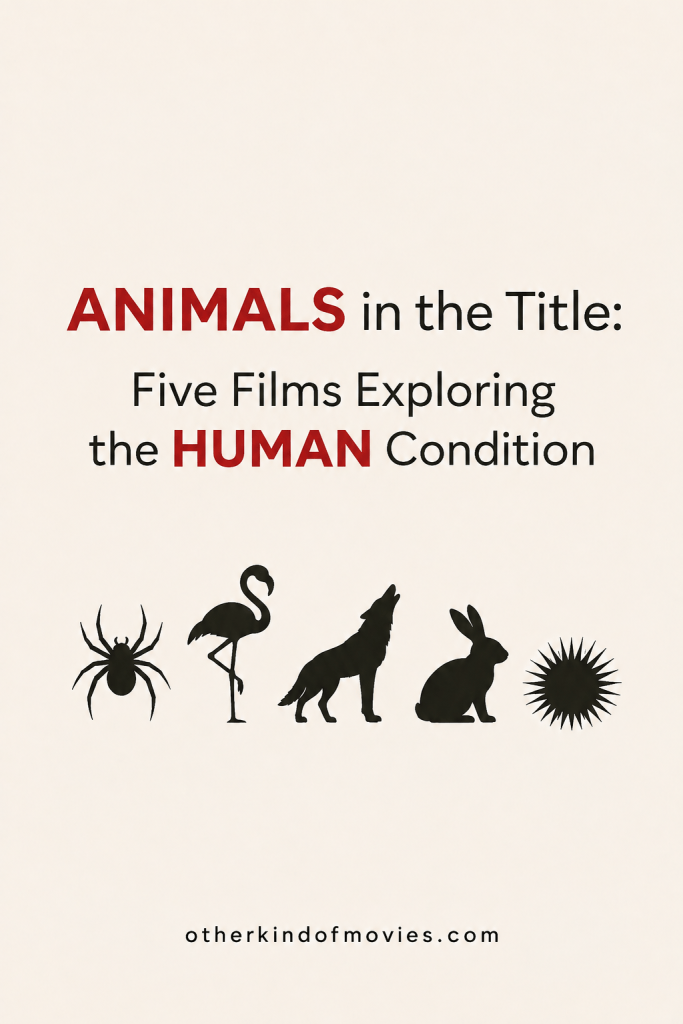
The spider represents predatory violence and the structures that protect it. The flamingo evokes visibility, difference and vulnerability. The coyote embodies human contradictions and our relationship with the natural world. The rabbit symbolises compassion in an environment that celebrates cruelty. And the urchin suggests the defensive instincts of someone struggling to survive.
None of these films is primarily about animals. All five are about being human.
Perhaps that is why animal imagery remains such a powerful element of cinematic storytelling.
By associating human experiences with creatures that inspire fear, affection, curiosity or admiration, filmmakers invite us to recognise familiar qualities from a different perspective.
And sometimes, an animal in a film’s title tells us more about its characters than their own names ever could.
