
For anyone interested in discovering cinema beyond the usual European and American festival circuit, the Busan International Film Festival has become an essential event. Since its creation in 1996, the South Korean festival has helped introduce international audiences to filmmakers from across Asia, often providing early recognition to directors who would later establish important careers.
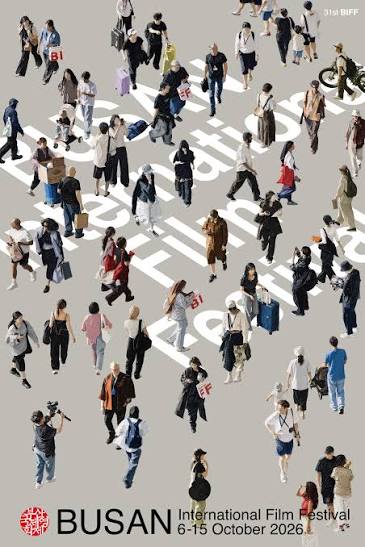
The 31st edition, held from 6 to 15 October 2026, represented a particularly significant moment in that history. Busan arrived with newly recognised international status, a competitive section entering its second year and an ambitious programme bringing together established filmmakers, emerging directors and films from countries that remain underrepresented in international distribution.
The festival presented 316 films from 59 countries, including 69 titles in its Community BIFF programme, across 31 screens in eight cinemas. Of the 247 films in the main programme, 95 were world premieres.
Yet the most important development was institutional. For the first time, Busan took place after receiving A-list accreditation from the International Federation of Film Producers Associations (FIAPF), joining a group of internationally recognised competitive festivals that includes Cannes, Berlin and Venice.
The distinction reinforced Busan’s growing position in world cinema, but it also raised an interesting question: how would a festival historically associated with discovering Asian talent adapt to its increasingly prominent role on the international stage?
The answer, at least in 2026, was to place Asian cinema even more firmly at the centre of its identity.
An Iranian Film Takes Busan’s Highest Honour
The festival’s most prestigious award went to Midday Meal, directed by Iranian filmmaker Majid Majidi.
Majidi is hardly an unfamiliar name to international audiences. His earlier films, including Children of Heaven, The Color of Paradise and The Song of Sparrows, established him as one of Iran’s most recognisable directors, particularly for his compassionate portrayals of ordinary people confronting difficult circumstances.
With Midday Meal, he added another major distinction to his career: the Busan Award for Best Film, accompanied by a prize of 50 million South Korean won, shared between director and producer.
The jury praised the film’s restrained storytelling and humanistic perspective, particularly its treatment of fate, suffering and tragedy.
Its victory was significant for another reason. Under the festival’s new international recognition, the winner of the Busan Award for Best Film became eligible for submission to the Academy Awards’ Best International Feature Film category, subject to the Academy’s applicable rules.
That does not automatically make Midday Meal an Oscar contender selected by Iran, but it gives Busan’s principal award a new institutional significance.
The competition was judged by a seven-member jury chaired by Zhang Yimou, one of China’s most internationally celebrated filmmakers. Thirteen Asian films competed, with an increased proportion of world premieres compared with the competition’s inaugural edition in 2025.
Other prizes reflected the geographical diversity of the selection.
Indonesian filmmaker Eddie Cahyono received the Special Jury Prize for IBUKU, while Taiwanese director Lee Yun Chan won Best Director for To Be Ordinary.
The acting award was shared by Zhou Xun, recognised for the Chinese film The First Taste of Loneliness, and Himeno Kashun, for Japan’s Satoko Always. The First Taste of Loneliness also received the Artistic Contribution Award for Li Danfeng’s sound design.
The results offered an encouraging picture of contemporary Asian filmmaking: established directors alongside newer voices, and recognition extending across Iran, Indonesia, Taiwan, China and Japan.
Main Awards – Busan 2026
| Award | Winner |
|---|---|
| Busan Award for Best Film | Midday Meal – Majid Majidi (Iran) |
| Special Jury Prize | IBUKU – Eddie Cahyono (Indonesia/Japan) |
| Best Director | Lee Yun Chan – To Be Ordinary (Taiwan) |
| Best Actor | Zhou Xun – The First Taste of Loneliness (China) |
| Best Actor | Himeno Kashun – Satoko Always (Japan) |
| Artistic Contribution | Li Danfeng, Sound – The First Taste of Loneliness |
| New Currents Award | Birds in the Dark – Shashank Walia (India) |
| New Currents Special Mention | Beach Fictions – Lim Hayeon (South Korea) |
New Currents – Discovering the Next Generation
Although the new Competition section attracted much of the attention, New Currents remained one of Busan’s most important platforms for emerging Asian filmmakers.
The New Currents Award went to Birds in the Dark, directed by Shashank Walia from India. South Korean filmmaker Lim Hayeon received a Special Mention for Beach Fictions.
These results illustrate an important distinction between Busan and many other international festivals. The event has never been interested exclusively in presenting the latest work of established auteurs. Discovering filmmakers before they become internationally recognised has been central to its identity from the beginning.
Other sections extended that commitment. The Vision programme highlighted independent cinema from Korea and across Asia, while A Window on Asian Cinema offered a broader overview of the region’s filmmaking.
One of the most notable successes was the Mongolian-German production Zogsool, directed by Sakhya Byamba. The film received several distinctions, including the NETPAC Award, the FIPRESCI Award and the Vision of Jiseok Award.
The Philippine co-production Ria, directed by Arvin Belarmino, received the Heart of Eurasia Award, while Japan’s After the Song, directed by Kumamoto Ryohei, won the Face of the Future Award.
These are precisely the kinds of films that make Busan worth following. Productions from Mongolia, the Philippines, Kazakhstan or other less internationally visible film industries can receive recognition alongside work from the region’s established cinematic powers.
And that recognition matters when theatrical distribution remains uneven across international markets.
Michelle Yeoh, Ann Hui and a Celebration of Asian Cinema
Beyond the competitive awards, the festival honoured two particularly influential figures in Asian cinema.
Michelle Yeoh received the Asian Filmmaker of the Year Award, recognising a career that has connected Asian cinema with international audiences for decades.
From her early work in Hong Kong action cinema to Crouching Tiger, Hidden Dragon, Crazy Rich Asians and her Academy Award-winning performance in Everything Everywhere All at Once, Yeoh has built a career that crosses languages, genres and national film industries.
Her recognition felt especially appropriate at a festival devoted to strengthening the international visibility of Asian cinema.
Hong Kong filmmaker Ann Hui received the Camellia Award, celebrating her contributions to cinema and the representation of women in the film industry.
Hui’s career, which includes Boat People, A Simple Life and The Golden Era, has consistently explored questions of identity, displacement, history and social change. Her films have played an important role in establishing Hong Kong cinema as something far broader than the action films for which it is often internationally recognised.
The Korean Cinema Award went to Kim Dong-ho, former chairperson of the Busan International Film Festival, whose work was instrumental in the event’s development.
Together, these tributes connected Busan’s past with its future: the individuals who helped establish Asian cinema internationally, and the filmmakers now benefiting from the institutions they helped build.
Opening Night and the Wider Programme
The festival opened with The Table: Day and Night, directed by South Korean filmmaker Kim Jong-kwan.
Its selection placed Korean cinema at the centre of the opening ceremony, while the wider programme brought together major international figures and filmmakers working across very different traditions.
Among the festival’s notable guests were Alfonso Cuarón, Hirokazu Kore-eda, Lav Diaz, Charlotte Gainsbourg and Fan Bingbing, alongside prominent Korean filmmakers including Lee Chang-dong, Na Hong-jin and Kim Jee-woon.
Lee Chang-dong’s presence was particularly noteworthy following the international attention surrounding Possible Love.
Busan also offered masterclasses and discussions with filmmakers such as Cuarón, Diaz and Na Hong-jin, expanding the event beyond screenings into conversations about the artistic possibilities of contemporary cinema.
Its Forum BIFF, held from 8 to 11 October, explored how cinema might develop amid changing technologies, production practices and audience expectations.
The festival’s commitment to connecting cinema with the wider public was equally visible through Community BIFF and BIFF Everywhere, initiatives designed to bring screenings and cultural activities beyond conventional festival venues.
These programmes help explain why Busan has developed such a strong relationship with its host city.
La Bola Negra Finds Another Audience
One of the most interesting results outside the Asian competitions came from Spain.
La Bola Negra, directed by Javier Calvo and Javier Ambrossi, won the Flash Forward Audience Award, adding another distinction to its international festival journey.
The film had already attracted considerable attention at Cannes, Toronto and San Sebastián, and its success in Busan offered further evidence of its ability to connect with audiences far beyond Spain.
For readers of Other Kind of Movies, this is an especially familiar title. We recently reviewed La Bola Negra, exploring its relationship with Federico García Lorca, the Spanish Civil War and the historical silencing of homosexual lives.
Its recognition in South Korea is particularly interesting because so much of the film’s cultural and historical context is specifically Spanish. That audiences in Asia have responded to it suggests that its broader themes — identity, repression, family memory and the consequences of silence — can resonate across very different societies.
The award also demonstrates that, despite Busan’s primary focus on Asian cinema, the festival continues to provide an important international platform for films from elsewhere.
More Than 200,000 Admissions
The 2026 edition also achieved an important milestone in audience participation.
According to the organisers, the festival recorded more than 200,000 cinema admissions, surpassing that threshold for the first time since 2015. Nearly 77,000 additional attendances were recorded for other programmes and events, with overall participation increasing by approximately 40,000 compared with the previous year.
These figures matter because they suggest that Busan’s growing international reputation is accompanied by strong public interest.
The Asian Contents and Film Market, held from 10 to 13 October, also reinforced the festival’s industrial importance. More than 30,000 visitors attended the market, where 339 companies from 32 countries participated as exhibitors.
Busan is therefore not simply a place where finished films are screened. It is also a meeting point where projects are developed, financing is discussed and filmmakers establish relationships that may determine which stories reach international audiences in the coming years.
Asian Cinema Looking Beyond Its Borders
The 31st Busan International Film Festival will be remembered for several reasons.
Majid Majidi’s Midday Meal became the festival’s principal winner. The new Competition section consolidated its position. Emerging filmmakers from India, Mongolia, Indonesia and Taiwan received important recognition. Michelle Yeoh and Ann Hui were honoured for careers that have helped shape the international perception of Asian cinema.
And with its newly acquired A-list status, Busan entered a different stage in its institutional history.
Yet the festival’s greatest strength remains the same as it was when it began three decades ago: its ability to bring attention to films and filmmakers that might otherwise struggle to find an international audience.
The future of Asian cinema will not be determined exclusively by the established industries of Japan, South Korea, China or India. It will also emerge from smaller productions, unexpected collaborations and filmmakers working in places that rarely dominate international cinema headlines.
Busan provides a space where those voices can be heard.
The challenge now is to ensure that the festival’s growing prestige does not overshadow the spirit of discovery that made it important in the first place.
For the complete programme, award winners and further information, visit the official Busan International Film Festival website
