
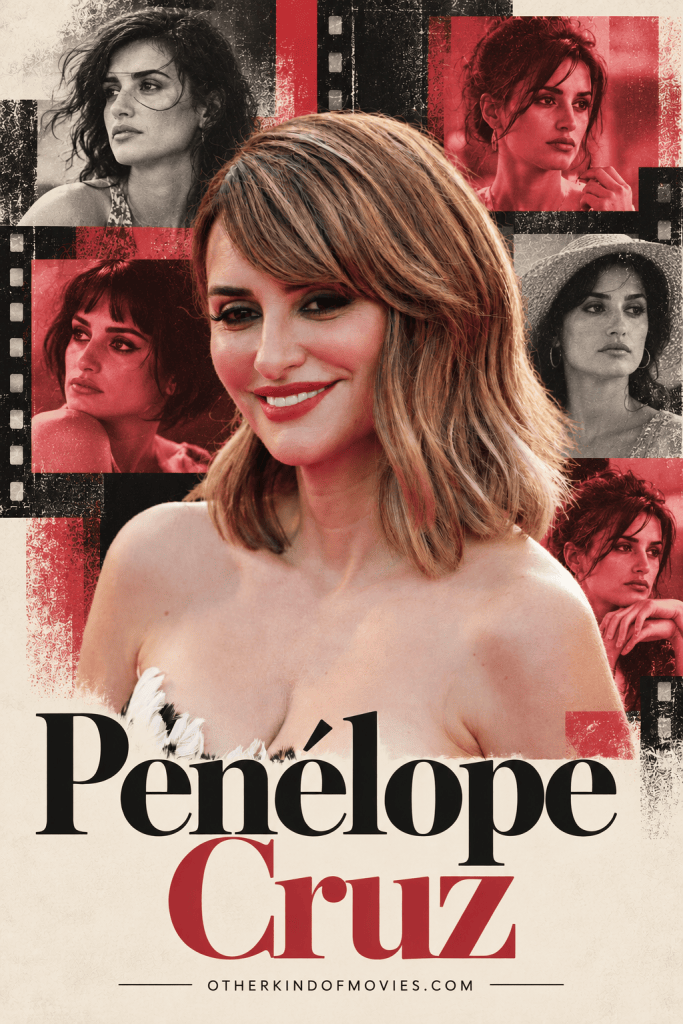
Few Spanish actors have achieved the international recognition of Penélope Cruz, and even fewer have managed to maintain such a strong connection with their country’s cinema after becoming Hollywood stars. More than three decades after her breakthrough, Cruz remains one of the most recognisable faces of Spanish filmmaking, an actress whose career has moved between Madrid, Rome, Paris and Los Angeles without losing the intensity and emotional authenticity that first made her stand out.
Her achievements are extraordinary. She became the first Spanish actress to win an Academy Award, has received four Oscar nominations, won major prizes at Cannes and Venice, and developed one of the most important creative partnerships in contemporary European cinema with Pedro Almodóvar. Yet reducing her career to international awards would overlook what makes Cruz particularly interesting: her willingness to portray complicated women, frequently caught between desire, family expectations, personal sacrifice and emotional contradictions.
From the youthful energy of Jamón Jamón to the devastating motherhood of Parallel Mothers, and from the exuberance of Volver to the emotional intensity of Ma Ma, Cruz has demonstrated a versatility that extends far beyond the image of the glamorous Spanish actress that initially accompanied her international success.
The Beginnings of a Spanish Star
Born in Alcobendas, near Madrid, in 1974, Penélope Cruz grew up in a working-class family and initially trained in classical ballet. Dance gave her a strong sense of discipline and physical expression, qualities that would later become evident in her performances.
Her fascination with acting developed during adolescence, and she began appearing in music videos and television before securing her first major film role.
That breakthrough arrived in 1992 with Jamón Jamón, directed by Bigas Luna.
The film, which also starred Javier Bardem, was provocative, sensual and unmistakably Spanish in its treatment of desire, class and social conventions. Cruz was still a teenager, yet her performance revealed an unusual confidence in front of the camera.
The same year, she appeared in Belle Époque, Fernando Trueba‘s affectionate comedy set in Spain during the early 1930s. The film won the Academy Award for Best Foreign Language Film, giving Cruz an early connection with the international recognition that would eventually define much of her career.
Throughout the 1990s, she continued working in Spanish cinema, appearing in films such as For Love, Only for Love, The Greek Labyrinth and Open Your Eyes.
The latter, directed by Alejandro Amenábar in 1997, became particularly important. Its psychological complexity and international success helped introduce Cruz to audiences beyond Spain. She would later reprise her role in the American remake, Vanilla Sky (2001), opposite Tom Cruise.
By the end of the decade, Cruz had become one of Spain’s most promising young actresses. But the collaboration that would transform her artistic identity had already begun.
Pedro Almodóvar and a Defining Creative Partnership
It is difficult to discuss Penélope Cruz without discussing Pedro Almodóvar.
Their first collaboration came with Live Flesh (1997), in which Cruz appeared in a relatively small but memorable role. Two years later, she played Sister Rosa in All About My Mother, a film that won the Academy Award for Best Foreign Language Film and further consolidated Almodóvar’s international reputation.
However, it was Volver (2006) that marked the true turning point in their relationship.
Cruz played Raimunda, a working-class woman navigating family responsibilities, grief and deeply buried secrets. Her performance combined strength, vulnerability, humour and an extraordinary emotional presence. It was also a role rooted in a recognisably Spanish social and cultural environment, particularly the lives of women whose resilience often goes unnoticed.
The film earned Cruz her first Academy Award nomination for Best Actress, while she shared the Best Actress Award at Cannes with the film’s ensemble of female performers.
Volver remains one of her defining performances because it captures so many aspects of her talent: the ability to communicate through small gestures, the intensity of her emotional reactions and the naturalness with which she moves between comedy and tragedy.
Her subsequent collaborations with Almodóvar included Broken Embraces (2009), I’m So Excited! (2013), Pain and Glory (2019) and Parallel Mothers (2021).
The latter deserves particular attention.
In Parallel Mothers, Cruz plays Janis, a photographer whose experience of motherhood becomes entangled with questions of identity, personal responsibility and Spain’s unresolved historical memory.
It is one of her most mature and emotionally demanding performances. Almodóvar allows her character to be loving, selfish, frightened and morally uncertain, and Cruz embraces those contradictions without attempting to make Janis consistently sympathetic.
Her work earned her the Volpi Cup for Best Actress at the Venice Film Festival and another Academy Award nomination for Best Actress.
Across their collaborations, Almodóvar has repeatedly challenged Cruz to explore different forms of femininity. Their films have also evolved together: from the colourful melodrama of the late 1990s to the more introspective treatment of motherhood, memory and ageing that characterises their recent work.
For Cruz, the partnership has been more than a succession of successful films. It has provided an artistic home to which she can return while continuing to develop internationally.
Hollywood, an Oscar and a Career Beyond Borders
While her collaborations with Almodóvar were central to her artistic development, Cruz was simultaneously building an international career.
During the early 2000s, she appeared in American productions including Blow, Captain Corelli’s Mandolin, Vanilla Sky and Sahara. These films introduced her to much larger audiences, although they did not always offer characters with the depth she had already demonstrated in Spanish cinema.
Her international breakthrough as a dramatic actress came through a rather different project: Don’t Move (2004), directed by Italian filmmaker Sergio Castellitto.
Playing Italia, a vulnerable woman whose relationship with a successful surgeon becomes increasingly destructive, Cruz delivered one of the most physically and emotionally demanding performances of her career. Her transformation was striking, challenging conventional expectations surrounding her appearance and screen persona. The role earned her Italy’s David di Donatello Award for Best Actress.
Then came Vicky Cristina Barcelona (2008).
Woody Allen’s romantic drama brought Cruz together with Javier Bardem and Scarlett Johansson. As María Elena, a volatile artist whose emotional intensity disrupts the lives of those around her, Cruz delivered a performance that was simultaneously explosive, funny and deeply vulnerable.
In 2009, she won the Academy Award for Best Supporting Actress, becoming the first Spanish actress to win an Oscar. The performance also earned her a BAFTA.
Her success continued with Rob Marshall’s musical Nine (2009), which brought another Academy Award nomination, this time for Best Supporting Actress.
Over the following years, Cruz moved comfortably between large commercial productions and smaller European films. She appeared in Pirates of the Caribbean: On Stranger Tides, Murder on the Orient Express and Ridley Scott’s The Counselor, while continuing to seek more challenging material elsewhere.
That ability to maintain two very different careers has been one of her greatest achievements.
Hollywood gave Cruz international visibility, but European cinema has frequently offered her the most complex characters.
The Performances That Reveal Her Range
Looking beyond her most celebrated collaborations reveals an actress particularly drawn to women facing difficult emotional circumstances.
In Ma Ma (2015), directed by Julio Medem, she played Magda, a woman confronting serious illness while attempting to preserve her sense of humour, independence and connection with others. The film’s emotional intensity depended heavily on Cruz’s ability to portray vulnerability without reducing her character to suffering.
In Everybody Knows (2018), Iranian director Asghar Farhadi brought her together again with Javier Bardem. Set in a Spanish village, the film explores family secrets, personal responsibility and the tensions that emerge when a crisis exposes long-buried conflicts.
Cruz’s performance as Laura demonstrated her ability to work within Farhadi’s restrained, morally complex storytelling, where the most important emotions often emerge through hesitation, silence and small changes in behaviour.
Her work in Italian cinema has been equally important.
In L’immensità (2022), directed by Emanuele Crialese, Cruz played Clara, a mother living in 1970s Rome whose unhappy marriage and relationship with her children form the emotional centre of the film.
The role allowed her to explore motherhood from another perspective: a woman whose love for her children coexists with her own frustration, loneliness and desire for freedom.
Then, in Ferrari (2023), she portrayed Laura Ferrari, the wife and business partner of Enzo Ferrari, played by Adam Driver.
Michael Mann‘s film could easily have relegated Laura to the background of a story about a famous man. Cruz, however, gives her a formidable presence. Her character is grieving, furious and unwilling to surrender her influence over the family business. The performance captures a woman whose personal and professional life has become inseparable from the ambitions of her husband.
These films illustrate something important about Cruz’s development. Her career has become increasingly interesting as she has moved beyond the roles traditionally associated with youth and glamour.
She has grown into an actress particularly skilled at portraying women whose emotional lives are too complicated to be easily categorised.
La Bola Negra and Her Place in Contemporary Spanish Cinema
In 2026, Cruz returned to Spanish cinema with La Bola Negra, directed by Javier Calvo and Javier Ambrossi, popularly known as Los Javis.
Cruz plays Nené, joining an ensemble that includes Glenn Close, Lola Dueñas, Miguel Bernardeau, Carlos González, Milo Quifes and Guitarricadelafuente.
The production represents another significant step in the international rise of Los Javis. It competed at the 2026 Cannes Film Festival, where the directors shared the Best Director prize, before continuing its international festival journey.
For Cruz, the project is also an interesting reminder of her position within Spanish cinema.
More than thirty years after her debut, she remains an actress whose participation can bring international attention to an ambitious Spanish production. Yet she is also willing to become part of an ensemble rather than insisting on occupying its centre.
Her presence alongside performers from different generations reflects a broader transition taking place in Spanish filmmaking. Directors who emerged through television, streaming platforms and unconventional storytelling are now developing projects with major international ambitions.
Cruz belongs to an earlier generation of Spanish cinema’s international expansion, but she continues to participate in its evolution.
Could the 2027 Oscars Bring Another Historic Moment?
The 2027 Academy Awards could mark another interesting chapter in Cruz’s career.
The actress has been discussed in connection with several potential awards contenders, including La Bola Negra, Olivia Wilde’s The Invite and Bunker. Although their awards prospects remain uncertain, the possibility of Cruz attracting attention for more than one performance in the same season is remarkable.
Particularly intriguing is the conversation surrounding her supporting performances in La Bola Negra and The Invite. Both have been mentioned as possible contenders for Best Supporting Actress, although neither nomination has been confirmed.
A change in the Academy’s rules also makes this awards season unusual. Performers may now receive more than one nomination in the same acting category for different films, opening the theoretical possibility of Cruz competing against herself.
Such an outcome would be exceptional, and it would be premature to suggest that it is likely. The official nominations will not be announced until 2027, and the competition remains considerable.
Nevertheless, the fact that Cruz continues to be discussed in connection with several internationally visible productions says something important about her longevity.
More than three decades after her film debut, she is not simply celebrating past achievements. She is still seeking demanding roles, collaborating with filmmakers from different generations and creating new possibilities for her career.
Whether or not the coming awards season brings another nomination, Penélope Cruz remains one of the few Spanish performers whose work consistently attracts attention on both sides of the Atlantic.
Awards, Recognition and an Enduring Legacy
Penélope Cruz’s list of distinctions is exceptional.
Alongside her Academy Award and four Oscar nominations, she has received three Goya Awards, the Best Actress Award at Cannes, the Volpi Cup at Venice, a BAFTA, an Honorary César and the Donostia Award at the San Sebastián International Film Festival.
She has also received Spain’s National Cinematography Award, recognising her contribution to the country’s film industry.
Yet perhaps her most important achievement is less easily measured.
Cruz helped transform the international perception of Spanish actresses at a time when opportunities in Hollywood were still limited and frequently shaped by stereotypes. Her success demonstrated that a Spanish performer could become an internationally recognised star without abandoning European filmmaking or her native language.
And while she has worked with some of the world’s most celebrated directors, her filmography remains remarkably varied.
There is the youthful spontaneity of Jamón Jamón, the maternal strength of Volver, the emotional volatility of Vicky Cristina Barcelona, the moral complexity of Parallel Mothers and the barely contained anger of Ferrari.
These characters are very different, but they share something essential: Cruz allows them to be contradictory.
Her women can be loving and selfish, courageous and frightened, generous and destructive. She rarely attempts to make them entirely likeable, and that willingness to embrace imperfection has become one of the defining qualities of her acting.
At 52, Penélope Cruz has already achieved more than most actors could reasonably hope for in an entire career. But what makes her particularly compelling today is that she does not seem interested in simply repeating the performances that made her famous.
Her work continues to move between languages, countries and cinematic traditions, connecting the Spanish films that established her reputation with the international productions that expanded it.
Penélope Cruz is no longer simply a Spanish actress who succeeded in Hollywood. She is an international actress who has never stopped being an essential part of Spanish cinema.
And after more than three decades on screen, that may be the most impressive achievement of all.
